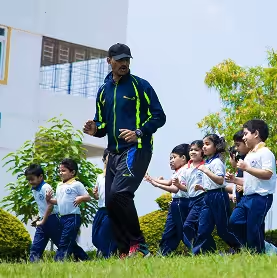
Something is quietly going wrong in India’s classrooms, and it is not visible on a report card. Across the country, school-going children are spending increasingly large portions of their day seated and disengaged from physical activity. Screen time is rising. Structured play is diminishing. And the physiological consequences are beginning to show at scale.
According to the 14th Annual Health Survey by Sportz Village EduSports, 40% of children fall outside the healthy BMI range. Additionally, the WHO highlights that 74% of Indian children (between 11 and 17 years) are insufficiently physically active. India now ranks second globally in the number of children who are obese and overweight, with projections suggesting that by 2040, nearly 20 million Indian children could be clinically obese.
The good news is that India’s policy architecture has never been better aligned with action. The Khelo Bharat Niti 2025 (also known as the National Sports Policy), along with several other programs, has done something no previous frameworks dared: it has formally elevated Physical Education (P.E.) from a marginal, often-skipped subject to a mainstream discipline. The national vision is clear: to move sports from an extracurricular afterthought to an integral part of how India educates its children.
But a framework can only produce change when it is operationalised at the school level. The seven-point roadmap below is a practical guide for school leaders ready to make that shift.
1. Make P.E. Time Non-Negotiable with At Least Three Structured Sessions Every Week
In most Indian schools, P.E. usually receives only one period a week, occasionally two. Several national and international studies recommend a minimum of three structured P.E sessions per week for children to see measurable fitness gains. One of those sessions, specifically, should be dedicated to fitness development; cardiovascular work, strength circuits, endurance progressions and not simply a match or a free-play session.
The evidence backs this up firmly: schools that log more than 80 structured PE sessions annually produce a higher proportion of students who meet fitness benchmarks than their peers with low P.E. exposure. Moreover, children who are fitter often score significantly higher on standardised tests of attention and working memory. Hence, PE time, used well, is academic time.
2. Use Short Movement Breaks Between Lessons to Improve Attention
Even three weekly P.E. periods may leave children with five largely sedentary school days. Research published by the WHO Europe and multiple peer-reviewed studies confirm that even short 5–10 minute classroom movement breaks, which educators now call “brain breaks,” measurably improve attention, on-task behaviour and mood across the remainder of the school day.
Schools that introduce structured active recess zones, walking routes in corridors and movement prompts between lessons are not sacrificing academic time. They are investing in it. In a generation where screens compete with every waking minute, the school environment may be the last reliable space to build a daily movement habit.
3. Treat P.E. Teachers’ Capacity Building as a Strategic Priority
The TOT initiative under the Khelo India program has trained approximately 60K+ P.E. teachers since its launch, a remarkable foundation. Yet on the ground, a P.E. teacher’s capability remains one of the most inconsistent variables in achieving a school’s fitness outcomes.
The gap between a P.E. teacher who delivers structured fitness programs and one who simply oversees free play is vast and is evident in students’ fitness levels.
Schools should move beyond one-time training events toward continuous professional development, such as annual certification in fitness pedagogy, refresher training programs, regular observation and mentoring cycles. A P.E. teacher should be capable enough to develop targeted improvement plans for the cohorts of students performing below the fitness benchmark.
When P.E. teachers are held to the same standard of professional growth as the academic faculty, P.E. delivery changes. And when P.E. delivery changes, student fitness follows.
4. Redesign a Fitness-Linked P.E. Curriculum with Developmental Outcomes
The “hand out the ball and let them play” model is obsolete. A fitness-linked curriculum maps each section, unit and grade to specific developmental outcomes such as cardiovascular endurance, muscular strength, coordination, flexibility and balance, and uses sports as a vehicle for achieving those outcomes.
Every P.E. session should ideally include a structured warm-up, fitness circuits or endurance components and a cooldown.
By tracking class-wise fitness across the year, schools can move from subjective grading to objective growth. National fitness studies clearly show that the overall fitness among a cohort of students who were part of a structured P.E program for two consecutive years improved from 66% in 2023 to 82% in 2025, reflecting a 16 percentage point increase.
After all, a relay race does not build a child’s lungs — but a structured running program, repeated week after week, does.
5. Turn Parents into Partners in Building Healthy Habits
Health and fitness often dip over the weekends, a pattern many educators describe as the “weekend slump,” where playtime is replaced by screen time. Schools cannot solve a lifestyle problem alone.
Global research on school-based health programs confirms that meaningful parental involvement amplifies health and fitness outcomes among children. Schools can encourage this through quarterly family fitness events, home activity challenges and workshops on sleep, nutrition and sedentary habits.
When parents understand that physical fitness enhances Brain-Derived Neurotrophic Factor (BDNF) — essentially “fertilizer” for the brain — they become the school’s strongest allies in student wellness.
6. Track and Review Student Fitness Data at an Institutional Level
If we don’t measure it, we cannot manage it. Physical fitness must be integrated into the school’s core reporting structure. Term-wise fitness dashboards should be a permanent fixture in academic leadership meetings.
At-risk cohorts should be identified early and supported with targeted plans. When P.E. outcomes are woven into school improvement planning and treated with the same seriousness as their academic counterparts, something shifts.
The culture of the school changes, and that culture ultimately results in the overall development of children.
7. Audit Space and Equipment to Ensure Daily Play Time
Even the most thoughtfully designed fitness programs cannot compensate for the absence of space and equipment. In schools with adequate sports infrastructure, access is often uneven across grades.
Schools must audit playground access to ensure that all grades receive daily time outdoors and equip these spaces with basic props such as cones, ropes, agility mats and skipping ropes.
They should also designate indoor contingency spaces, whether an empty hall or a modified classroom, so that weather disruptions never result in a “free period.”
Conclusion
The health of India’s children is at a crossroads. Classrooms designed to build the nation’s intellectual capital must also strengthen a child’s physical, mental and emotional well-being.
Schools therefore face a clear choice: continue treating P.E. as a break from learning, or recognise it as a powerful driver of learning itself. When children run, jump, balance and build strength, they not only become fit; they also develop the neurological foundations for focus, resilience and long-term health.
The seven strategies outlined here are neither expensive nor complex. They are practical, evidence-based steps within the reach of every school. What they require is intentional leadership, consistency and a commitment to treating physical development with the same seriousness as academics.
The evidence is already clear: children need to move more. The question is whether schools are ready to redesign the school day to make that movement inevitable.
Authored By:
Divyadeep Singh Hada
Head – Product Development & Training
Sportz Village