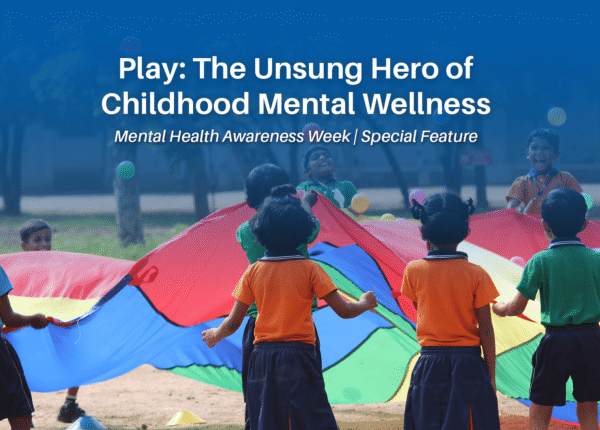
We often talk about what children eat, how much they sleep, and how well they do academically. But somewhere along the way, we stopped asking simpler, more fundamental questions: Are our children happy? Are they getting enough time to play?
This Mental Health Awareness Week, it’s time to reframe the conversation because play and physical activity are not rewards for finishing homework. They are not “extras” to be scheduled when everything else is done. They are, in fact, one of the most powerful mental health interventions we have for children.
Movement Deficit: When Children Stop Playing, Mental Wellness Suffers
The numbers are telling: A National Mental Health Survey observed that the prevalence of mental conditions is estimated to be 7.3% among children aged 13-17 years, affecting boys and girls in near-equal measure. Yet most interventions focus on treatment rather than prevention. We cannot solve this crisis with more counselling sessions alone. We need to look upstream — at the daily habits, environments, and experiences that shape a child’s developing mind. And right there, hiding in plain sight, is physical play.
The World Health Organization recommends at least 60 minutes of moderate-to-vigorous physical activity every day for children aged 5-17. A large proportion of Indian children fall short of this benchmark, a gap that widened sharply in the post-pandemic years and has yet to fully close.
What fills that gap? Screens, largely. And while technology is not the enemy, passive screen time, or doomscrolling, does not offer the sensory richness or physical release that movement does. A child who spends most of their after-school hours on a device is, neurologically speaking, still “on.” The consequences show up as irritability, poor sleep, and difficulty concentrating. These are not character flaws, but physiological signals that the body and brain are not getting what they need.
The Movement Mental Wellness Connection
When a child runs, jumps, kicks a ball, or plays a game of kabaddi with friends, something remarkable happens inside their brain. Physical activity triggers the release of endorphins, serotonin, and dopamine, the very neurochemicals that regulate mood, motivation, and resilience. For a child navigating the pressures of modern schooling, 30 to 60 minutes of daily play acts as a natural “reset button” for the nervous system.
Regular play rewires the brain, strengthening the prefrontal cortex, the area responsible for emotional regulation, impulse control, decision-making, and confidence. Team sports add another dimension: belonging. Being part of a team, wearing the same colours, working towards a shared goal, these experiences create identity and community, two of the strongest buffers against anxiety and depression in young people.
This is precisely what NEP 2020 recognises when it calls for the integration of P.E. and sports as a core, non-negotiable part of the school curriculum.
How Schools and Parents Can Support Children’s Mental Well-being Through Play
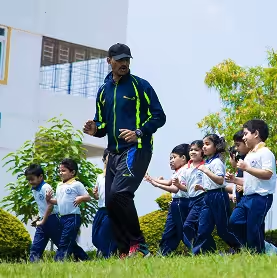
Every child deserves to experience the joy of playing, whether that’s a game of gilli-danda in a narrow lane, a structured football session on a school ground, or a yoga class in a corridor. When children play, they are calmer, more focused, and kinder to each other. They develop a quiet confidence that doesn’t come from marks or medals alone. Schools and parents are the two most important stakeholders in getting children to play.
School leaders can:
- Create dedicated, structured playtime protected in the school timetable, without any substitution.
- Organise annual health assessments to track their students’ fitness and physical development with the same rigour applied to tracking academic performance.
- Invest in training and capacity building of P.E. teachers, thereby enabling them to understand physical literacy, well-being, and cognitive development through movement, not just sport technique.
- Create safe spaces, literal and cultural, where play is celebrated, and every child is included.
- Align sports and P.E. programs with the NCF and NEP 2020 frameworks to ensure holistic development of every child.
Parents can:
- Resist the urge to fill every hour with structured academic activity.
- Engage in play with their children, outside, away from screens.
- Talk about sport and movement in terms of joy and health, not just achievement and competition.
- Notice if their child has stopped playing. It is often one of the earliest signs that something is wrong.
Putting Play Back at the Centre of Childhood & Mental Wellbeing
We have spent decades measuring children’s success almost exclusively by exam scores. It is time to broaden the lens. New metrics worth asking: How often do children laugh out loud? Do they have friends they play with? Can they handle losing a game without falling apart?
The Rights of Children to Free and Compulsory Education (RTE) Act guarantees children not just a seat in a classroom, but a safe, enabling environment for holistic development. And play could be a vital element to that vision.
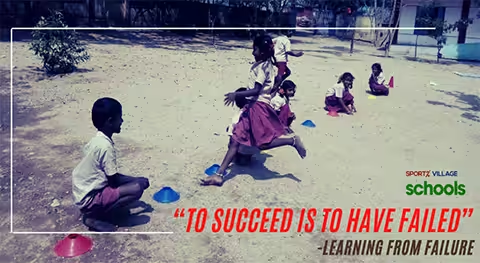
A child who plays is a child who is processing the world. Learning to fail and try again. Building, day by day, the mental architecture that will carry them through the storms of adolescence & adulthood.
This Mental Health Awareness Week, let’s make a collective commitment to put play back at the centre of childhood, because a child in motion is a child in balance.