In 2026, the Ministry of Education intensified its work on a National School Mental Health and Well-Being Policy. By June, the policy is progressing through advanced stages of review, with Union Education Minister Dharmendra Pradhan chairing meetings with officials and domain experts. An implementation timeline is yet to be announced, but the conversation has begun.
Discussions around the draft policy have highlighted the need for stronger mental-health awareness, early identification mechanisms, counselling support, and school-wide well-being systems. All critical priorities. But for any of it to work at scale, schools need to look beyond the counsellor’s room. They need to look at the playground.
The scale of India’s school mental health challenge demands more observation points than counsellors alone can provide
India has approximately 1.5 million schools and over 250 million enrolled students. Delivering meaningful mental health support across this landscape is not just a policy challenge; it is a logistical one of staggering proportions.
Even the most well-designed policy will depend on a network of adults who can recognise early signs of distress and connect students with appropriate support before a moment of struggle becomes a moment of crisis. Counsellors are essential, but they cannot be everywhere. Schools need more eyes, more relationships, and more entry points.
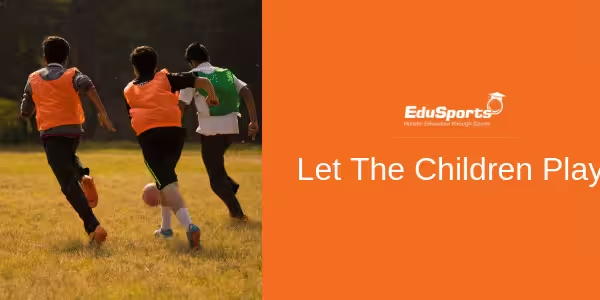
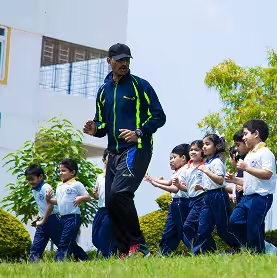
In this ecosystem, P.E. trainers could play an important role. Unlike many classroom interactions that are centred around academic performance, P.E. and sports sessions allow trainers to observe students in dynamic social environments where behaviours such as participation, emotional regulation, peer interaction, resilience, and withdrawal often become more visible.
The warning signs are already in plain sight
The numbers demand attention. A cross-sectional study published in 2025 involving school-going adolescents in South Delhi found that 25.92% showed symptoms of depression and 13.70% showed symptoms of anxiety. Moreover, as per the National Crime Records Bureau (NCRB) Accidental Deaths & Suicides in India 2022 report, India recorded over 13,000 student suicides, that is, roughly 35 students every single day.
These are not abstract statistics. They show up in classrooms, in corridors, and most visibly, on sports fields and in P.E. sessions, in a child who no longer participates, the one who has sudden outbursts during team games, or the one who withdraws into the corner during free play.
The Ministry’s policy review process reflects increasing attention to these concerns. What it now needs is the right human infrastructure to act on early signals, before they become crises.
P.E. trainers as first-line observers of student well-being
Research literature suggests that P.E. teachers may be particularly well positioned to identify early signs of emotional and behavioural concerns because they observe students in active, socially dynamic settings.
This aligns with broader school mental-health frameworks that emphasise early identification and support. Current discussions around school mental-health frameworks increasingly recognise teachers as important adults who may notice early signs of distress and help connect students with support. The P.E. trainer can serve as an important first-line observer within this ecosystem, complementing the insights of classroom teachers, counsellors, and school leaders. The key, however, is building that observation into a system, not leaving it to intuition.
Three practical ways P.E. trainers can support wellness counsellors and school leaders
1.Structured observation protocols linked to referral pathways:
P.E. trainers should be equipped with training and tools to observe and log behavioural flags during sessions. These do not need to be complex. A simple weekly check-in format, noting changes in participation, social behaviour, or emotional regulation, creates a living record that a school counsellor can use to prioritise check-ins and interventions.
As schools strengthen their mental-health support structures, referral pathways can help ensure that concerns identified by educators are escalated appropriately. The sports field can offer valuable behavioural observations precisely because it is unguarded; children reveal themselves in play in ways they rarely do in structured academic settings.
2.Sport as a social-emotional curriculum, not just a physical one:
Schools that design their P.E. and sports programs with explicit SEL outcomes, not just fitness benchmarks, give their counsellors a parallel therapeutic environment. Team sport, when facilitated deliberately, teaches empathy (through shared goals), frustration tolerance (through losing), emotional vocabulary (through post-game reflection), and trust (through reliance on teammates).
A P.E. trainer who debriefs after a match, who names emotions in the moment (“That was a tough loss. How are you all feeling?”), and who celebrates effort over outcome is doing social-emotional learning that is difficult to replicate in traditional classroom settings. The counsellor’s role then becomes deeper clinical support, while the P.E. trainer builds the emotional muscle memory that makes that support more effective.
When P.E. teachers collaborate with counsellors to embed SEL frameworks into sports sessions, covering topics like de-escalating conflict, communicating under pressure, and taking accountability, this can strengthen students’ self-awareness, communication, and relationship-building skills.
3.Sports as anti-stigma infrastructure:
Perhaps the most underrated contribution a P.E. program can make to school students’ mental health is normalising emotional expression in a high-participation, peer-validated environment.
One of the biggest barriers to the new policy’s success will not be the absence of counsellors. It will be stigma. In most Indian schools, “going to see the counsellor” still carries a social cost for a child. The sports field carries far less of that stigma. It is a space where showing emotion is already normalised, where a child can be visibly frustrated, elated, tired, or overwhelmed without it being labelled as weakness or disorder.
A P.E. trainer who creates psychologically safe team environments, where vulnerability in sport is reframed as strength, is doing preventive mental health work at scale. They are building the emotional permission structure that makes a child more likely to seek help when they need it.
What school leaders can do now?
1.Integrate P.E. trainers into the wellness team:
Whether through a counsellor, student wellness lead, or designated coordinator, mental-health efforts are most effective when they involve multiple stakeholders, including the P.E. department. A monthly review of participation patterns, behavioural observations from sports sessions, and flagged concerns should be a formal part of the school’s mental health monitoring process.
2.Build outcomes into P.E program design:
Schools should move beyond attendance and fitness metrics as the only measures of P.E. success. Social-emotional indicators, collaboration, resilience behaviours, and emotional regulation during competition should also be tracked and reviewed. Tracking these indicators can help schools evaluate the effectiveness of their well-being efforts and make evidence-based improvements over time.
3.Invest in P.E. trainer capacity building:
Policy discussions around school mental health have increasingly highlighted the importance of training educators in mental health awareness and psychological first aid. P.E. trainers should be explicitly included in this training cohort. Not to make them therapists, but to make them informed first responders who know when to refer, what language to use, and how to create environments where children feel seen.
Building a school mental health infrastructure that sees every child
The proposed policy has the potential to be a landmark step for Indian education. But a policy will only be as powerful as the people who implement it. India’s schools are too large, too diverse, and too under-resourced for implementation to rest on counsellors alone. Many schools already have P.E. trainers who interact regularly with large numbers of students across age groups. And they often work in one of the few school environments where students have the opportunity to express themselves more freely through movement, interaction, collaboration, and play.
The question is whether we give them the frameworks, the tools, and the institutional standing to translate what they observe into action.
A child who is struggling does not always raise their hand in a classroom. But they will often tell you something on the field, in how they play, how they respond, how they connect or fail to connect with their peers. The P.E. trainer is already listening. The time has come to make sure the system is too.