Ask ten school chains what makes them different, and you will hear roughly the same eight answers. Experienced faculty. Smart classrooms. Holistic development. Safe campuses. Board results. A robotics lab. A large playground.
None of it is untrue. All of it has now become the bare minimum a school can offer.
This is what happens as a category matures: The first campus differentiates on infrastructure. By the twelfth, infrastructure is the cost of entry, and the chain is competing with three similar schools within a six-kilometre radius, all making the same promises to the same parents. When promises converge, parents stop choosing on promise and start choosing on distance and fee. That is a difficult place for a chain that intends to keep opening campuses.
So the real question for a growing chain is not “what else can we add?” It is: what can we do consistently, across every campus, that our competitors cannot easily copy?
Sport and PE is one of the few honest answers left. And student wellbeing – as an outcome.
Why Sport and Physical Education is still an open, untapped space
Parent salience is rising. Screen time, sedentary childhoods, rising lifestyle risk, and a much more open conversation about children’s mental health have moved physical activity from “nice to have” to something parents actively worry about. That worry is unmet demand.
Policy has caught up. NEP 2020 and NCF 2023 position sport inside the core curricular experience rather than alongside it. NSP 2025 and Khelo India have made sport a national priority rather than a school-level preference. A chain investing in PE today is moving with regulation, not against it.
It is visible in a way academics are not. Academic quality produces a report card twice a year. PE produces a story every week, the child who came home and explained why she was picked for the relay, the parent who noticed their son can now hold a plank. Differentiation that a seven-year-old narrates at the dinner table is worth more than differentiation that lives on a brochure.
And almost nobody does it well at scale. In most chains, sport is a slot on the timetable, and the quality of that slot depends entirely on the individual coach standing in it, which means high perceived value and low competitive density, the two conditions a USP actually needs.
One caution before the how: Sport as a USP is not the same as producing athletes. A chain that stakes its differentiation on a medal count is building on the achievement of a handful of children and quietly telling the other 95% that PE is not for them. The differentiation lives in the median child, not the top 1%. Get that wrong and the whole thing becomes a trophy cabinet in the lobby.
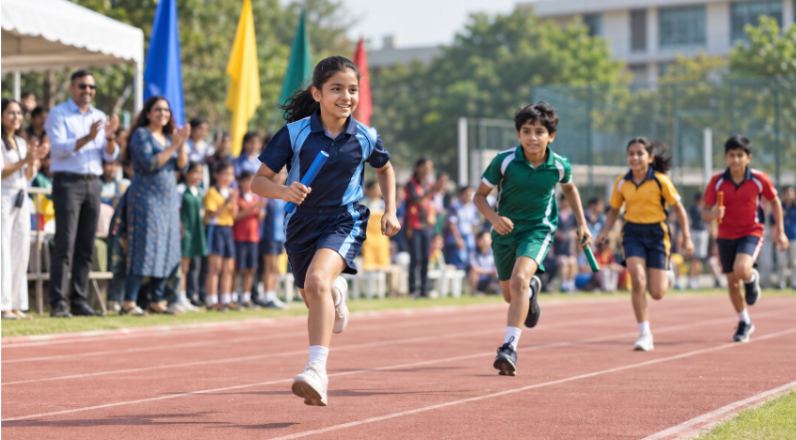
A strong PE system is designed around participation, progression and coaching quality, not just facilities.
Five things that school chains can do with an impactful sports and PE program
1. Define it: Say exactly what you’re promising
Before anything is built, the chain has to decide what its PE actually stands for. In one paragraph, in plain language, and specifically enough that it could be proved wrong.
“Holistic development through sport” fails that test. Something closer to “Every child from Nursery to Grade 12 gets structured physical activity four times a week, is assessed twice a year on fitness and motor skills, and leaves Grade 5 able to swim, catch, sprint and play three team games” passes it.
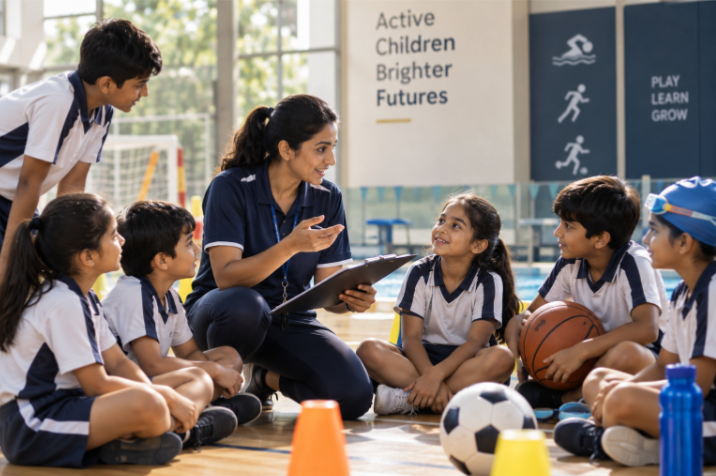
2. Standardise it: One program, not forty versions of it!
Variability is the enemy of a chain. A parent who moves from your Campus A to your Campus D should recognise the same program, not a different coach’s personal preferences.
Standardisation means a grade-wise curriculum with defined progressions, a fixed session structure, a defined equipment kit per campus, minimum minutes per week, teacher-to-child ratios, and a certification standard every PE trainer must clear before they take a class. It also means alignment with the boards you run. IB PYP, CBSE, ICSE, and State Board have different demands on the timetable, and a program that ignores that will lose its slot.
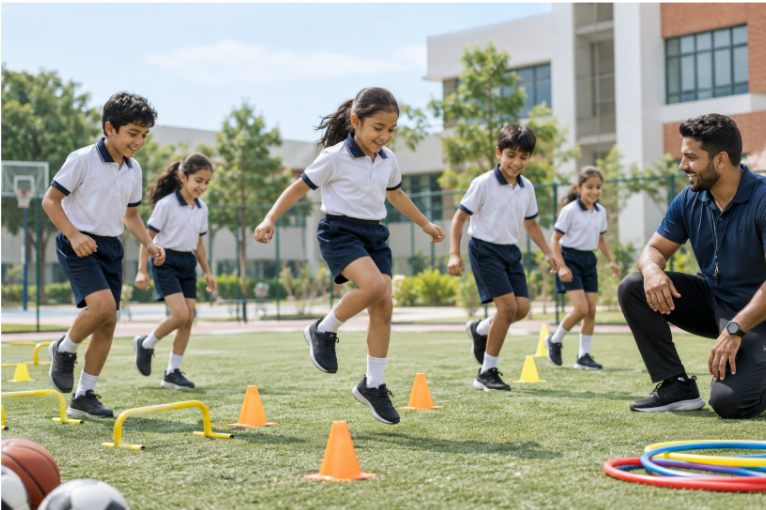
3. Measure it: Turn the claim into a number
This is the step that turns a claim into a category.
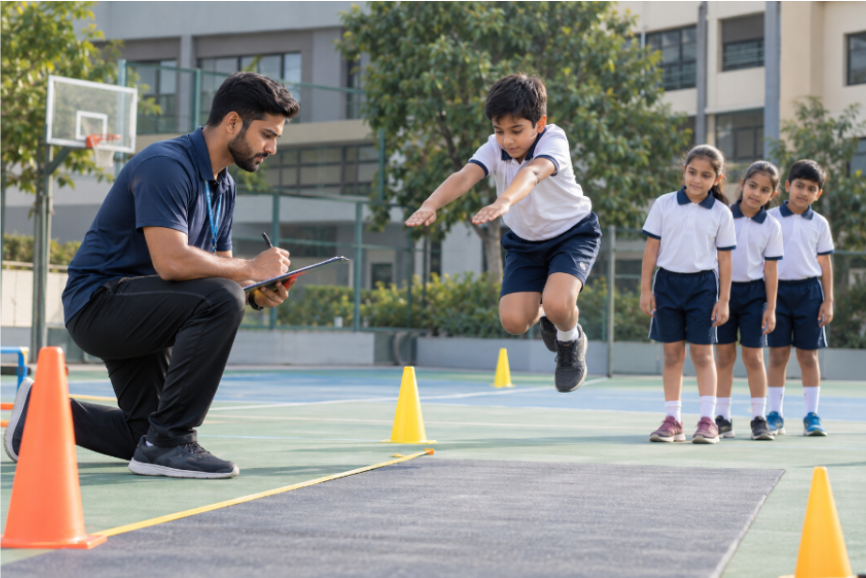
Measure two things. Capability: a structured annual or bi-annual fitness assessment covering body composition, flexibility, strength, endurance and agility, plus age-appropriate motor and sport skills. And engagement: participation rate, sessions actually delivered against sessions planned, and minutes of genuinely active time per child per week.
Measurement does three jobs at once. It gives the child a number that improves, which is motivating in a way a lecture about health never is. It gives the parent visible evidence of value. And it gives the chain’s leadership something it has never had for sport: comparability across campuses, so an underperforming campus shows up in a dashboard rather than in a complaint two years later.
4. Showcase it: Let the data do the talking
Proof beats adjectives. Once data exists, the chain has assets no competitor can imitate without doing the same work.
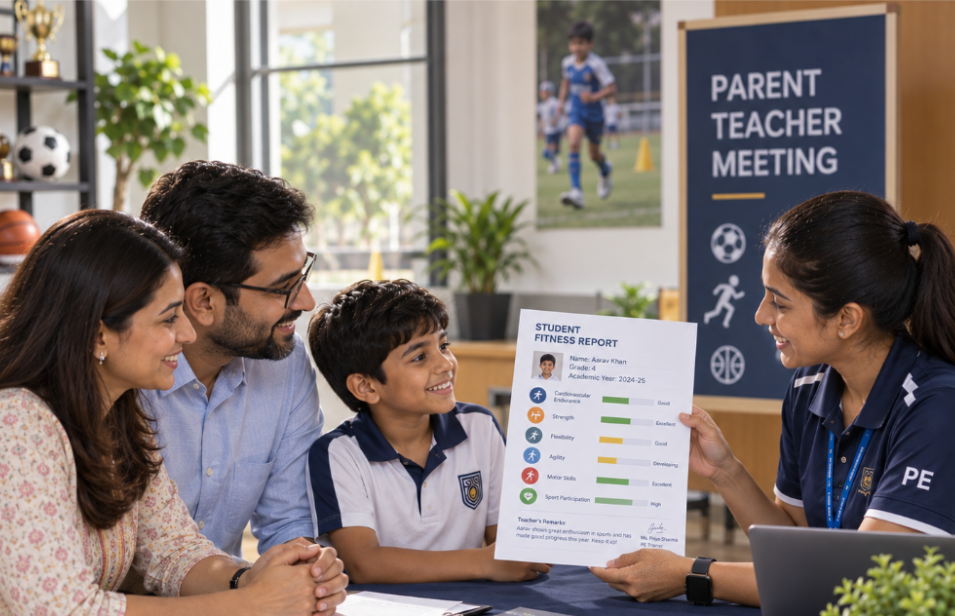
An individual fitness and skill report that goes home with every child. An annual chain-level health report, aggregated, anonymised, and genuinely newsworthy in a country where childhood fitness data is scarce. Inter-campus leagues that give the program a calendar and a narrative. A short PE section in every parent orientation, admission tour and open house. Trainer profiles, because parents trust people more than programs.
Marketing’s job here is not to invent a story. It is to stop a real one from going unreported.
5. Scale it: Solve for the trainer who isn’t a star
Scale is where most PE initiatives quietly die, and the causes are predictable.
Founder-trainer dependency: The program is excellent at the campus where a passionate head of PE Trainer works, and unremarkable everywhere else. Fix it with a central PE function that owns curriculum, hiring standards, and quality, not forty independent decisions.
Equipment as strategy: A chain buys kit, declares a sports initiative, and discovers eighteen months later that the equipment is in a locked storeroom. Fix it by budgeting per child per year for delivery and training, not per campus for purchase.
Launch-and-forget: No audit rhythm. Fix it with periodic session observations against a rubric, a live dashboard on delivery and assessment completion, and PE outcomes inside the campus head’s review, not outside it.
Scaling PE is an operations problem wearing a marketing costume. Treat it that way, and it holds.
The honest counter-argument
Three objections deserve a straight answer.
It costs money. Yes, trainers, assessment, equipment, central oversight. But compare it to the cost of a single additional campus, or of a fee increase that a parent cannot see the justification for. PE is one of the cheaper things a chain can be genuinely excellent at.
The timetable is already full. Also true, and board pressure in senior grades is real. Which is why the definition in step one has to be honest about grade bands rather than promising uniform intensity from Nursery to Grade 12 and then breaking that promise at Grade 9.
PE alone will not win admissions. Correct. Nobody enrols a child solely for PE. But USPs rarely work as the sole reason; they work as the tiebreaker between two schools a parent already considers acceptable, and as the reason existing parents stay and recommend. In a chain, retention and referral compound across campuses in a way admissions spend never does.
So, can it?
Yes, on one condition: that the chain treats PE as infrastructure rather than as an event.
The chains that will own this are not the ones with the biggest grounds. They are the ones that can tell a parent exactly what happens in a PE class on a Tuesday in Grade 3, show them what changed in their child’s fitness since last year, and deliver the same answer at every campus in the network.
Academic excellence is expected. Smart classrooms are expected. A PE program that is defined, standardised, measured, showcased and scaled is, for now, still rare. And rare is where differentiation lives.
This is the framework we’ve built our own in-school sport and physical education program around at EduSports, working with school chains across the country. If any of this resonates with where your schools are headed, happy to talk.
-
Why the Government should encourage Sports Development?
The headline might not have a very simple answer but it is a question worth pondering over. Let’s...
-
Transforming learning: Part-1
magine a rock-climber inching her way up a huge, ominous looking rock – completely absorbed in the intense...
-
India’s New School Mental Health Policy Already Has an Unlikely Ally: The P.E. Trainer
In 2026, the Ministry of Education intensified its work on a National School Mental Health and Well-Being Policy....